|
| |
| Genomic Services |
|
| Protein Services |
|
| |
| |
Located in rooms
B065 and B017
|
|
• Mass Mapping
• Edman Sequencing
• Mass Mapping (back to top)
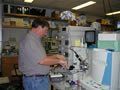
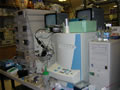
Most clients submit samples in SDS-PAGE gels, representing a single, well-resolved protein band. In fact, seemingly well-resolved bands often contain two or more proteins, and we will often detect two to four proteins in a single sample. Samples of greater complexity than this may generate a poor result. We digest samples with trypsin and analyze them with the 4700 Proteomics Analyzer using a combination of MS and MS/MS modes. We may employ a variety of search engines available on the internet; these programs perform a “best fit” mass analysis of both the peptide map (MS); and the fragmentation data (MS/MS), combined into a single searchable text file. The data is compared with theoretical digests for all proteins that are archived in one of the public databases. In
general we use “Mascot” for this purpose.
For each sample analyzed we return a Result Summary page on which the best match is listed at the top and alternative matches are given in descending order of probability score. It should be stressed that mass mapping generates inferential evidence of protein identity, as opposed to empirical protein sequence data that is generated, for example, by Edman degradation. The programs we use to match mass spectrometric profiles provide putative peptide sequence data corresponding to peptides from the matching protein.
|
|
• Edman Sequencing (back to top)
Amino acid sequences are reported using single-letter code for the twenty standard proteinogenic amino acids. For a variety of reasons, tryptophans, cysteines and amino acid residues containing side-chain modifications (e.g. phosphorylation) will generally be reported as blanks, as will most of the non-standard amino acids.
We often encounter samples containing mixtures of polypeptides. If a mixture contains two or more polypeptides, we may not be able to unambiguously order their sequences. In order to aid in the separation of such mixed sequences, we provide a very approximate estimate of the picomole yield for each amino acid and we order them in the report according to their relative molar abundances. However, the twenty standard amino acids differ widely in their stability to Edman chemistry, so the given ordering may be misleading.
When mixed sequences represent gene-coded proteins, the correct ordering can often be deduced by reference to the known sequence. However, for de novo (i.e. novel) sequences, correctly ordering a mixture of proteins depends upon a clear difference in protein abundance between the components of the mixture. If more than one amino acid is identified at a given cycle the investigator should use caution in assigning a specific amino acid to that position in the sequence. |
|
|